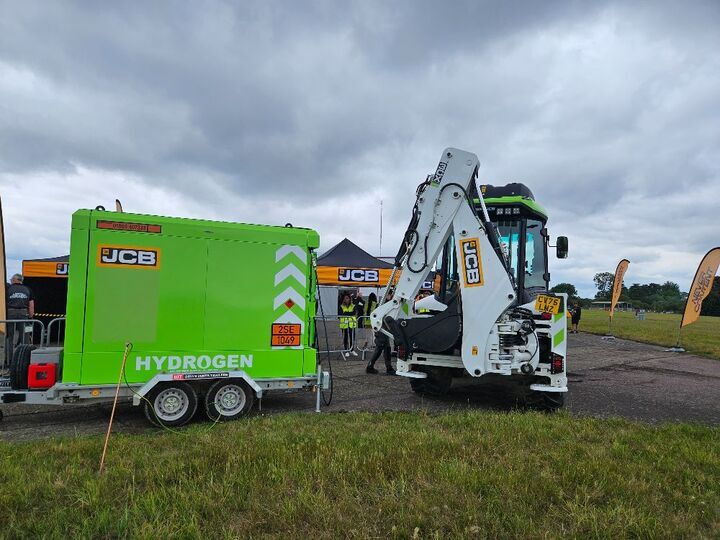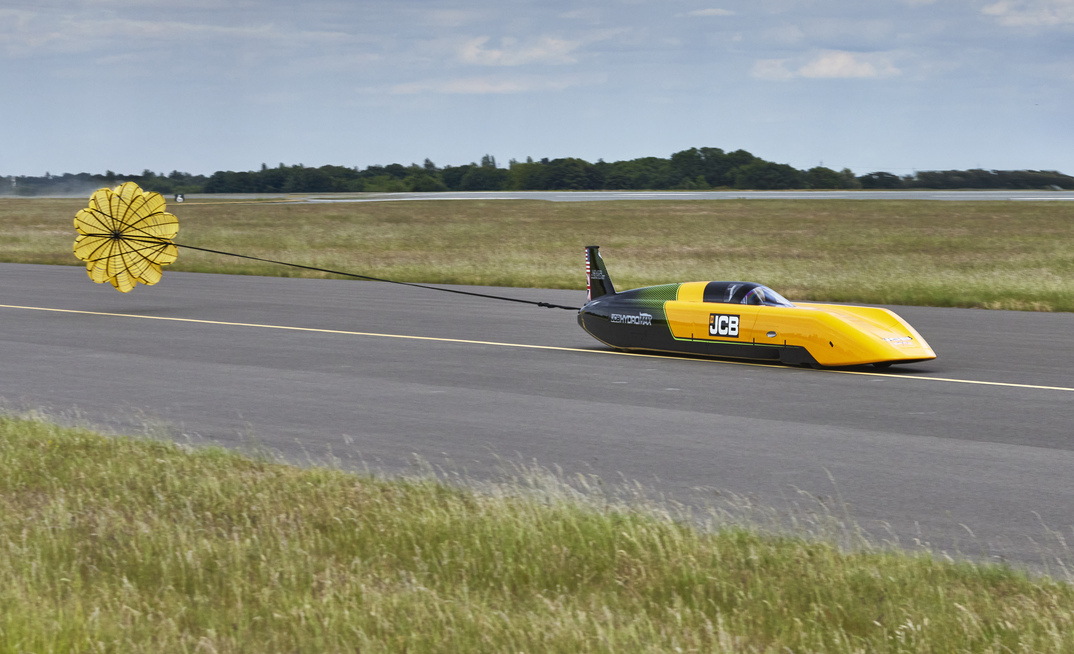


You might think there's not a great deal in common with a superfast supercar capable of 350mph and a 25mph construction machine like the 3CX backhoe loader, until you look under the bonnet (hood). Both are running on gaseous H2. And then when you realise Lord Bamford is involved you just know anything is possible.
It was on a sunny day at RAF Wittering, in the UK, last week that the pioneering JCB Chairman flew in to watch his JCB Hydromax, a car powered by two JCB hydrogen digger engines, reach 177mph on a test drive.
If all goes to plan, Bamford, 80, an engineer by profession, and the JCB team will take the car to the Utah salt flats in August with the aim of breaking the land speed record.
As it goes, it was twenty years ago that JCB took its conventionally-fuelled Dieselmax to Bonneville and set a then new world diesel-powered land speed record.
RAF Wing Commander Andy Green OBE drove the car at a record-breaking speed of 350.092 mph, and he hopes to do the same this year on hydrogen. (Green is currently the only person to break the sound barrier on land - 763.035 mph.)
But this is not just some flight of fancy or expensive hobby for the wealthy Baron. It's much more than that. It's about showing the heavy industries that the same machine performance, power, torque, and efficiency expected of a diesel engine can be delivered with a zero-emission H2 gas engine.
JCB has so far invested £100 million to develop hydrogen powered internal combustion engines and is certainly leading the way here.
The company now has mid-range machines powered by 55kW hydrogen engines on the production line, with the JCB 3CX Hydrogen, having passed over 25,000km of on-road validation, very much a contender to similar sized fossil fuel guzzlers.
JCB has long been an innovator, of course, and its alternative fuel research has resulted in hybrid engine arrangements, fuel cells and full electric configurations. But for mid-range machines, Hydrogen is considered the real deal. Indeed, Bamford says it's the "proper alternative" if the industry is serious about reducing its environmental impact.
There will be more on this in coming days, but hydrogen does look like an viable alternative.
Of course, fuel availability and mile-to-the-gallon issues need to be addressed, and you may need to tow your own hydrogen generators to the jobsite for a while, until the infrastructure is in place. But as Bamford says: "you don't need to take the fuel out of the ground. The fuel is in the water and it's very easy to make."
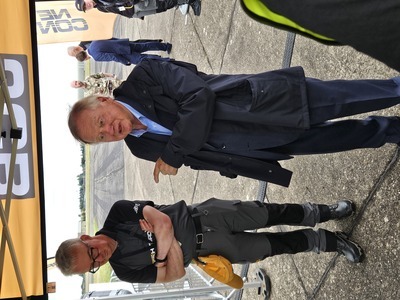
Commenting on the car itself, he said: "Twelve months ago this car was a set of drawings being discussed by a room full of engineers. Today, it is a reality and on wheels, running, and being tested in the UK. The team has done a wonderful job to get us to this point. Our focus now turns to the real challenge: setting a world hydrogen land speed record in Bonneville."
The JCB Hydromax is powered by two of the company's own production-based hydrogen internal combustion engines, producing a combined 1,600bhp – the same engines now powering JCB diggers.
About one kilometre of wiring runs through the car, while there has been extensive use of 3D-printed components to keep weight down and packaging tight.
The crankshaft is the same one JCB uses in its 448 hydrogen and diesel engines. The pistons alone require one litre of cooling oil every second to stop them overheating. A specially developed exhaust valve technology handles the temperatures generated by 1,600 bhp of hydrogen combustion.
Each titanium turbo compressor spins at more than 150,000 rpm at close to 300°C, pumping the equivalent of a standard bathtub of air every half-second. On a full record run, JCB Hydromax will consume just over two kilograms of hydrogen - and produce 18 litres of water.
If the JCB Hydromax does succeed and break records, it pushes the boundaries of hydrogen technology, demonstrating a possible green future for number of diesel-powered industrial sectors.