

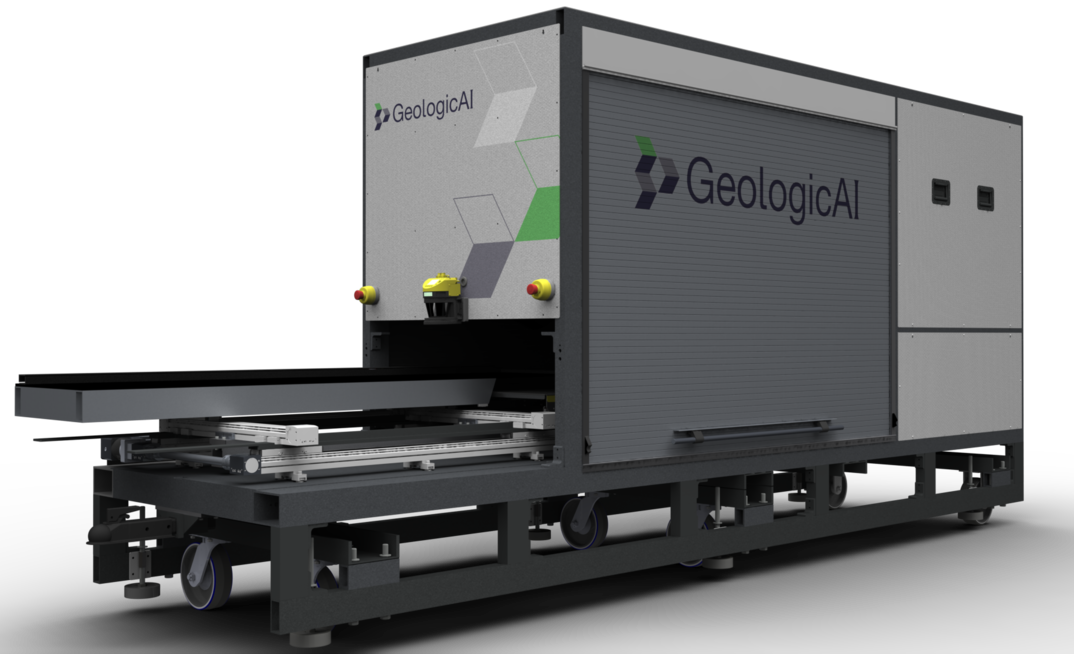


Artificial intelligence combined with robotics technology is beginning to transform how mining companies interpret drill core, enabling geological teams to analyse exploration samples faster and extract far more information than traditional workflows currently allow.
At the centre of this shift is the growing use of high-resolution data combined with machine learning models capable of analysing multiple geological variables simultaneously. Canada's GeologicAI is one company pushing the technological boundaries.

Using proprietary core sample scanning hardware and AI, its Core Scanner is helping geologists eliminate guesswork and improve workflow by detecting geological patterns in hours rather than the weeks it would normally take through manual interpretation.
YOU MIGHT ALSO LIKE
GeologicAI's approach focuses on combining several datasets from core samples, including elemental measurements, high-resolution imagery and tomographic data, and analysing them using AI. The resulting datasets capture not only the geology of the rock but also structure and texture to create what the company describes as a much richer dataset for AI analysis. "It's the rocket fuel for new types of analysis for artificial intelligence and machine learning," GeologicAI CEO Grant Sanden, tells GDI.
"It automates geological workflows, such as picking rock types or lithologies. AI engines can do a great job of that. You can get most of your lithologies picked, and you can look at the curves. That's where the geological value comes in. We can use it to size sulphides and deliver the textural analysis that leads to geo-metallurgical improvements."
According to Sanden, the use of AI in generating datasets more rapidly will change the speed of exploration. Data from scanned core can be processed quickly and interpreted, allowing exploration teams to begin analysing drilling results within hours rather than waiting for laboratory results, he says.
Investment support
While score scanning technology is still in the adoption phase, Rio Tinto and BHP have been early investors, supporting the company in funding rounds.
The latest round, Series B, led by Blue Earth Capital with participation from two of the world's largest mining companies, raised US$44M to accelerate AI-driven discovery and sale "high-resolution decision engineering" across the globe.
"Right now, we're in that deployment phase. But the value has been proven. People understand that core scanning is here to stay. We're entering the phase where people can see how much value this has. There are certain types of geology where it adds spectacular value, things like porphyry deposits, for example."
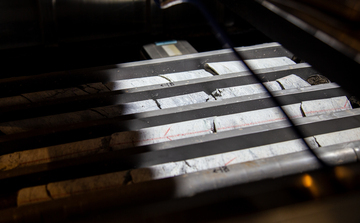
Most core can be assessed using the technology, but Sanden is particularly animated when it comes to iron ore, indicating that a recent study showed a 5% blast-furnace improvement by essentially modelling and remixing the rock type.
"If you did this for the whole industry, [in terms of CO₂ emissions] it would be equivalent to taking 40 million cars off the road in. It's such a large contribution."
GeologicAI currently has active Core Scanner units in the field scanning roughly 1.3 million metres of core per year. "But the market is huge," Sanden says. "Once AI proves its value, people use it. I think we're entering that era."
Lumo Analytics
The state-of-the art technology used in the Core Scanner is the Laser-Induced Breakdown Spectroscopy (LIBS) scanner developed by Lumo Analytics, which the company acquired last year.
LIBS is a rapid, non-destructive technique that uses a high-energy laser pulse to vaporise a tiny spot on a rock, creating a short-lived plasma which emits light unique to the elements present when it cools. This spectral "fingerprint" provides immediate chemical information about the material. For the mining sector, this means faster geochemical insights directly at the source, enabling more efficient exploration and resource evaluation.
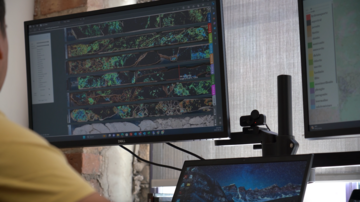
"The mining industry currently faces a 'critical minerals crisis', requiring faster and more accurate data to bring resources to market," says Sanden. "To address this, we are driving a strategy of bringing together enhanced data at the source, industry-specific domain expertise, and advanced, purpose-built analytics. This acquisition represents a key step forward in our mission."
LIBS technology
Capable of rapid, non-contact, non-destructive measurements, LIBS is taking off in the mining industry as a means of measuring light elements and rare-earth elements (REEs), allowing assessment of crucial deposits and providing detailed mineralogy.
LIBS technology, which complements GeologicAI's existing sensor stack, is critical for modern mining because it enables rapid, accurate measurements of elements that traditional sensors often miss. It extends the capabilities of its multi-sensor data products to drive additional high-resolution value.
This is something not lost on the big mining companies. Pekka Santasalo, Head of Growth & Ventures at Rio Tinto says as demand for critical minerals continues to grow, access to high-resolution, real-time geological data is becoming essential to improving decision quality and reducing risk.
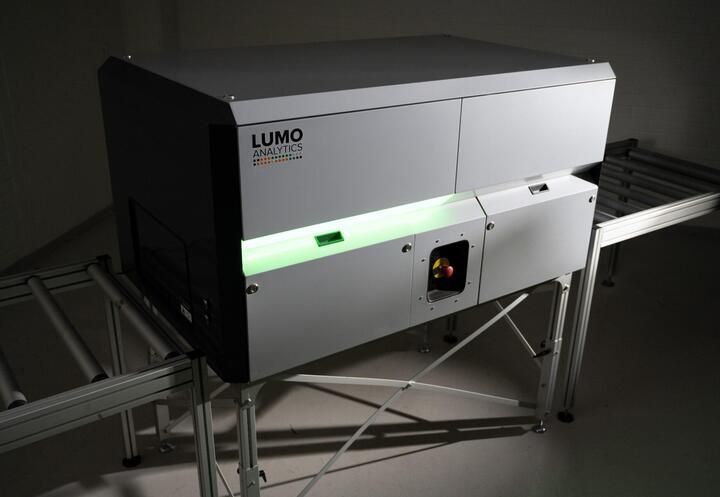
The combination of GeologicAI's multi-sensor platform with Lumo Analytics' LIBS technology is claimed to represent an important step forward in how the industry can better understand complex ore bodies and make more informed resource decisions.
"The idea is that this high-resolution data flows right from the technology into the models and into the next steps of the exploration process, how to drill, where to drill, what spacing should be used. We're seeing real optimisation efficiencies coming from that," says Sanden.
Human elements
He believes that GeologicAI's Core Scanner can also mitigate the risks associated with human error and the mistakes made in interpreting the data.
"Now that we can analyse thousands of variables and reconcile almost any type of information, that's a huge advantage compared to doing it by hand. In geology we are often dealing with only a tiny fraction of the available information. So, understanding and mapping uncertainty is a huge win for the industry."













