

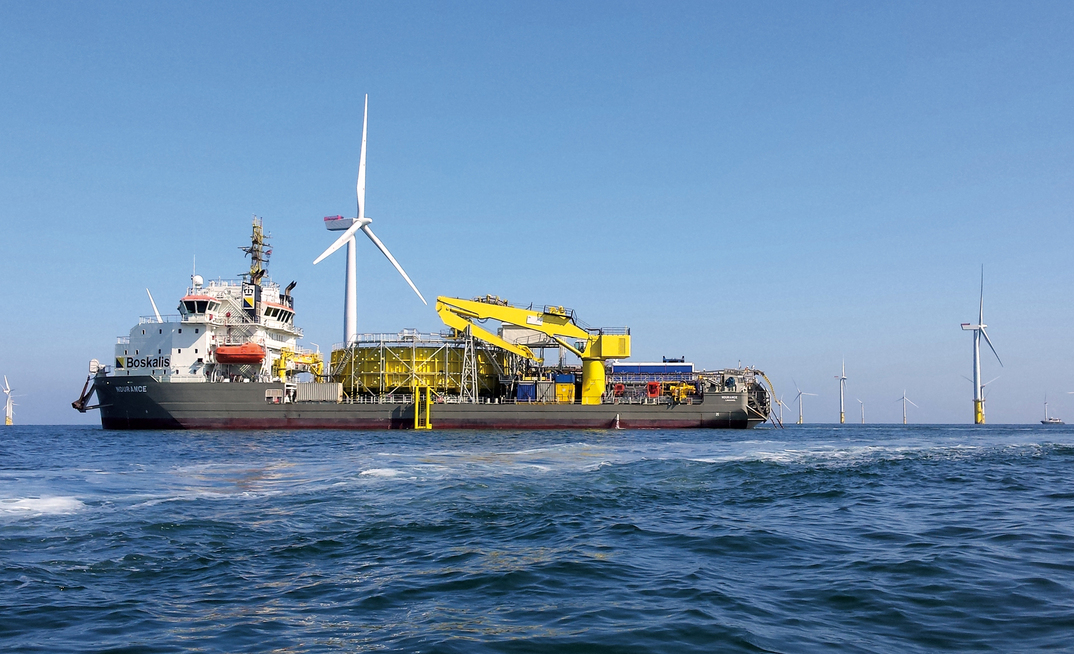


Dutch ship operator and dredging contactor Royal Boskalis is investing in a high-capacity Cable Lay Vesel (CLV) to meet growing demand for long-distance high-voltage cable installations in the offshore wind market.
While Boskalis "for commercial reasons" would not confirm whether the vessel set to enter service in 2029 will be a newbuild or conversion, it did say the ship will feature two 12,000t cable carousels, including a concentric carousel allowing for the installation of longer, continuous cable sections.
As more wind farms are developed further offshore, in deeper seas, cross-border interconnectors and higher-voltage offshore wind transmission systems will require long-distance cable solutions.
However, newbuild bottlenecks are likely to emerge in key shipbuilding and conversion regions.
YOU MIGHT ALSO LIKE
Market analysts have indicated that the global cable laying vessel market could hit US$3.91billion by 2032 as more countries invest in wind power to emissions targets. The European Union has already set an offshore wind target of 300GW by 2050, requiring a fleet of CLVs.
According to TGS | 4C, an offshore wind intelligence provider, while near-term supply remains broadly manageable in some markets, "longer-term constraints emerge as projects grow larger, more complex and more infrastructure-intensive".
In its Q1 Supply & Demand Offshore Wind Vessels and Transmission & Cables Outlook, the analyst says that over the past decade installed cables for offshore wind projects have increased from 9,000km in 2015 to 55,50km in 2025. The forecast is for additional 117,640km between 2026 and 2040.
Subsea interconnectors and high-voltage cables installed on the seabed between neighbouring countries or regions are expected to increase by 60,700km during the same period, it states.
While more cable laying tonnage is likely to enter the market, TGS | 4C believes bottle neck are emerging in key regions and demand may outpace available capacity.
Boskalis' Fleeming Jenkin was launched in October 2025 and her delivery is scheduled for the last quarter of 2026. The William Thomson will follow shortly and will be operational in the first half of 2027.
In April, dredging contractor and Boskalis competitorJan De Nul launched the second of two 28,000t subsea cable‑laying vessels. These sisters, currently the world's largest CLVs, have been designed to install cables, in shallow and ultra-deep waters down to 4000m.













