

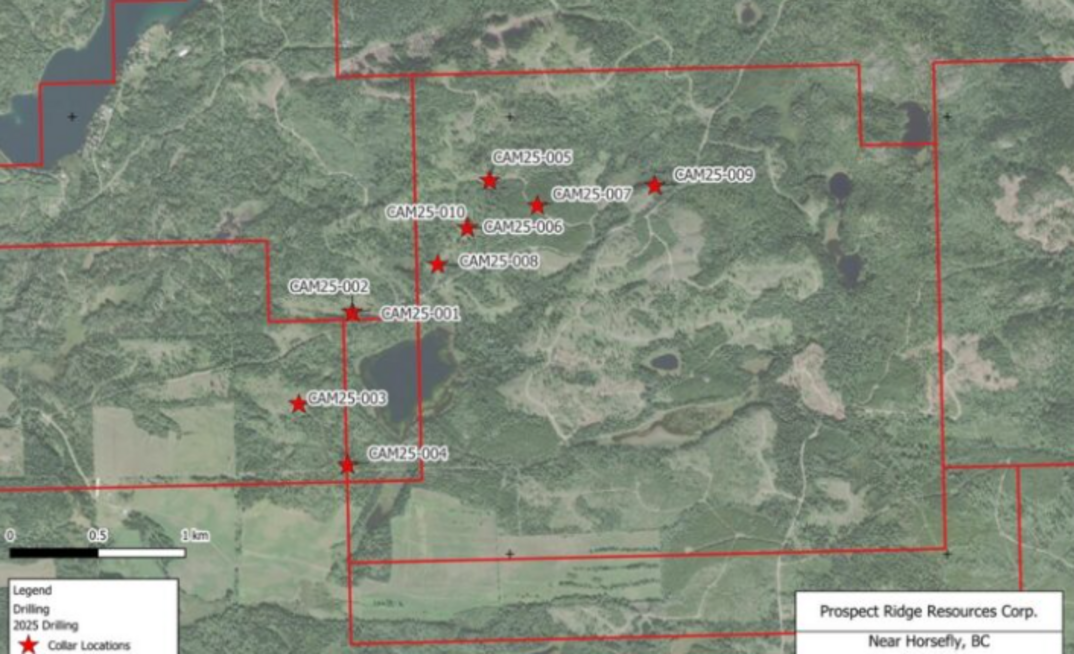


More details have emerged about the copper-gold-porphyry discovery at the Camelot Copper Gold project in British Columbia, with project owner Prospect Ridge Resources confirming a total of 2,034m was drilled in ten holes (CAM25-001 to CAM25-010).
Testing a 1.7km long prospective geochemical and geophysical trend, it was drill hole CAM25-009 with assays that returned 0.07g/t Au and 0.08% Cu over 156.6m from 23.4m depth.
The 2025 drill programme targeted historical Cu-in-soil anomalies coinciding with moderate to high resistivity and magnetic anomalies. Drills were developed for volcanic rock associated with alkalic porphyry - magmas that cool relatively close to the Earth's surface. Geophysical and geochemical features indicated pyrite-chalcopyrite mineralisation associated with magnetite-bearing potassic alteration.
Results of the programme could help better the industry's understanding of the geophysical and geological signatures relating to Cu-Au mineralisation, since hole CAM25-009 – associated with chargeability highs on the shoulder of a moderate magnetic anomaly – provided Prospect Ridge with new targeting criterion.
The prominence of pyrite over chalcopyrite indicated that that the core of the porphyry system has yet to be found, with a theoretical stronger (calc-)potassic alteration and potentially higher Cu-Au grades.
Dr. Len Brownlie, the CEO of Prospect Ridge, noted: "The inaugural drill programme, where nine of ten holes intercepted at least short intervals of copper mineralisation, has advanced our knowledge and understanding of our targeting criteria and provided hints that Camelot maybe a potential polyphase porphyry cluster. "
Going forward, he sees areas of high chargeability (>27 mV/V) on the shoulders of moderate magnetic anomalies will be a high priority target for deeper drilling at Camelot.
"We look forward to planning a follow-up work programme for Camelot in 2026 that entails advanced vectoring techniques to ensure a productive drill," he said.
The Camelot Property sprawls a 2646Ha area approximately 65km east of Williams Lake, B.C. within the Quesnel Terrane – home to multiple producing copper-gold and copper-molybdenum porphyry deposits, including the nearby Gibraltar and Mount Polley mines.
Camelot is located about 33km southeast of Imperial Metal's Mount Polley and 13 km northeast of Vizsla Copper's Woodjam project.













