

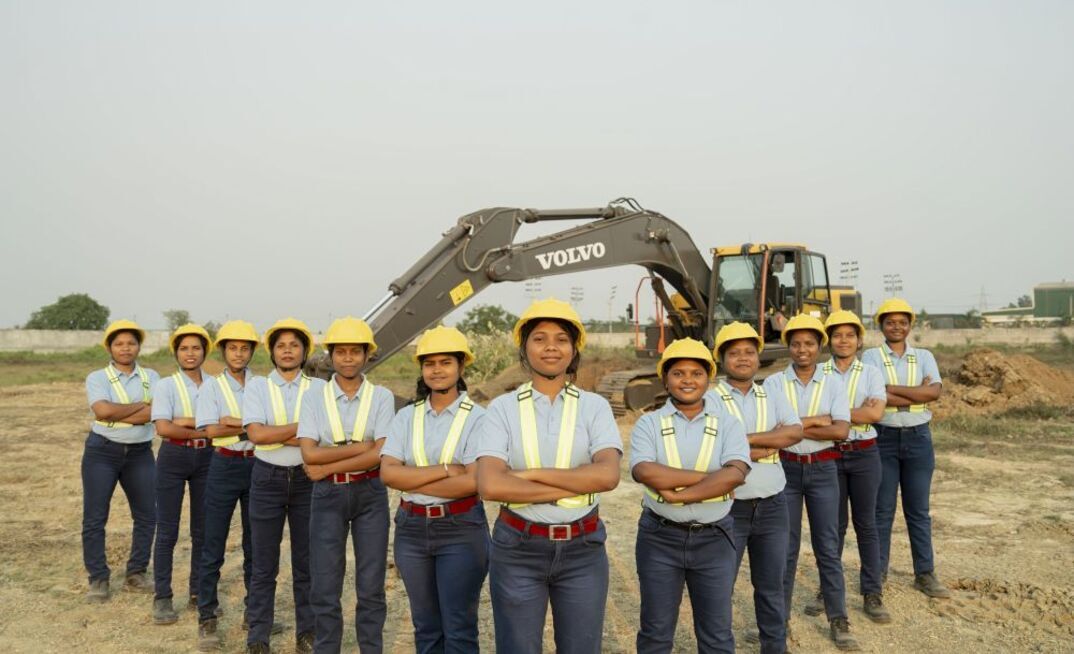


With a growing shortage of new entrants threatening to slow the industry's technical transformation, the wider adoption of an initiative adopted by Volvo Trucks in 2016 is plugging the skills gaps and attracting more women to the global mining and construction industries.
The "Iron Women" concept, which has already resulted in more than 700 women across 10 countries joining the construction industry in professional driving roles, is now being formalised by Volvo Construction Equipment as a unified global platform to attract new talent, particularly operators, technicians, and service professionals.
This is no symbolic gesture or a cynical attempt to jump on any "Me Too" bandwagon but a serious and workable business model that Volvo CE believes should be rolled out far and wide to expand the workforce and attract new recruits to the industry.
YOU MIGHT ALSO LIKE
No skills, no scale. It's that simple!
"No skills, no scale. It's that simple," says Melker Jernberg, President of Volvo CE. "We can develop the most advanced machines, the smartest products and solutions, and the cleanest technology, but none of it matters if there aren't enough skilled people to deploy it. Iron Women isn't about diversity for diversity's sake. It's about competence and growth, and the entire industry grows when we unlock capacity together."
In 2024, Volvo CE, a separate business unit of the larger group, adapted the model for construction equipment, launching its first programme in Ukraine to educate women as certified heavy equipment operators. Through partnerships with training provider ETS Group and Swedish non-profit Beredskapslyftet, the programme evolved to reskill more than 1000 women across myriad industries to support Ukraine's rebuilding efforts.
Indian shortage
A similar initiative launched in India last year. India, forecast for high-growth in a number of industrial markets, is facing an acute shortage of skilled labour. But by working with dealer partner Pollutech Engineering, mining customer KCCL, and government infrastructure institute IIIC Kerala, an Iron Women programme was adopted to recruit and train more women.
The programme offered three specialised tracks: operator certification, worksite technician training, and factory floor technician programmes. The first graduates achieved 100% placement and are now working at customer sites and dealerships. A second cohort of 25 women recently completed operator training and is entering placement.
"Where I come from, women are rarely encouraged to step into roles like this," says Laxmi Naik, a graduate Iron Woman.
"When I joined the programme, I carried a lot of hesitation about whether I could really succeed. But over time, the training and support helped me discover my own potential. Today, I walk away not just with skills, but with confidence and the belief that I can build a different future for myself."
Scalable models
With these kind of results, Volvo CE is now expanding Iron Women from regional pilot programmes into a scalable model to enable faster technology adoption, higher equipment uptime, and more resilient supply chains.
"The model works," Jernberg says. "The next step is scaling it and expanding Iron Women to build workforce capacity where it's needed most, at a pace that matches industry transformation."
Volvo's Iron Women will be rolled out across Denmark, Norway, Sweden, and Finland throughout the year.
Other manufacturers are adopting similar initiatives to address the looming skills shortage crisis, especially in India.
Komatsu , for instance, has partnered with India's Infrastructure Equipment Skill Council (IESC) to help train women as excavator operators. The programme delivers a blend of theoretical and practical hands-on-machinery training to develop professional excavator operators.
SANY is another. The Chinese manufacturer has supported the launch of the first all-women excavator operator training programme at the National Academy of Construction (NAC), in Andhra Pradesh, marking an important milestone for gender inclusion across India's mining and construction sectors.
A group of 22 women trainees completed the programme earlier this month, using a SANY SY120 Excavator.













