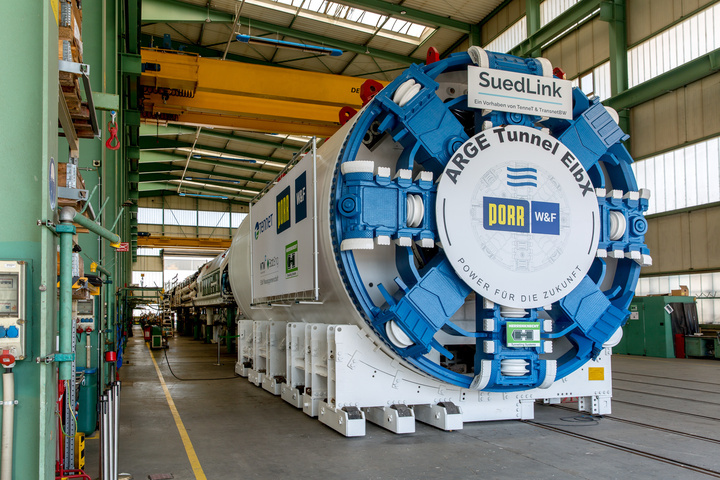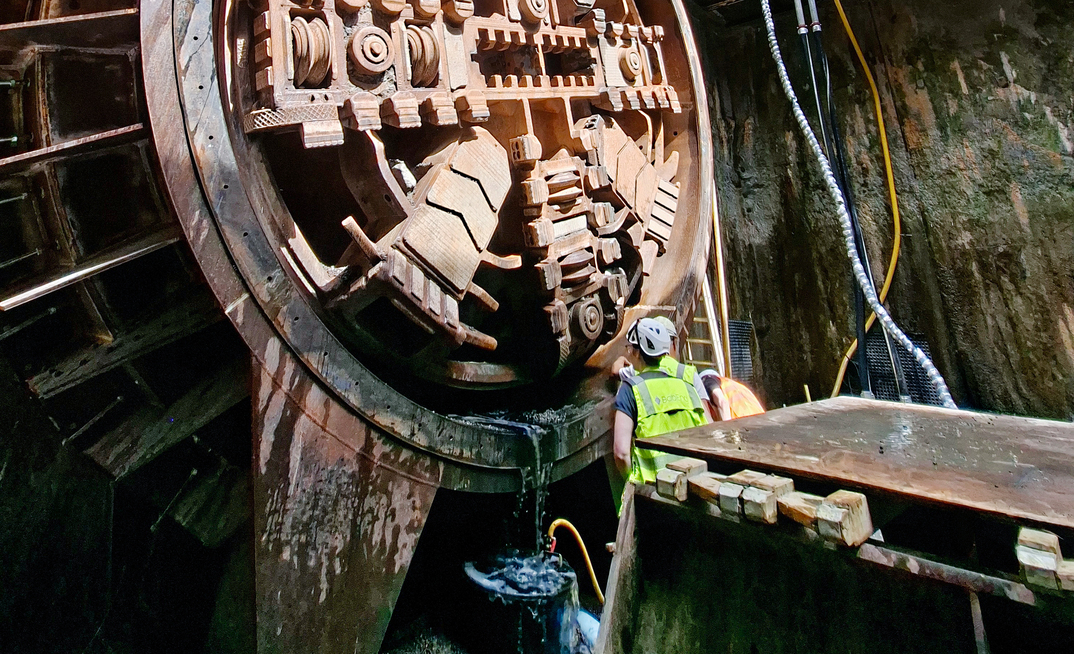


Herrenknecht's TBM "Elsa" has completed the 5.2km cable tunnel for the SuedLink Elbe crossing under 18 months, marking a major milestone in one of the country's largest energy infrastructure projects.
SuedLink is a major ultra-high-voltage direct-current (UHDC) transmission initiative aimed at strengthening Germany's power grid.
Stretching 700km, the "electricity highway" will connect offshore and onshore wind energy sources in northern Germany with key industrial regions in the south, particularly Bavaria and Baden-Württemberg.
Operated by TenneT Germany and TransnetBW, the link will carry up to 4 GW of electricity.
YOU MIGHT ALSO LIKE
A key part of the project is the Elbe crossing, where 525kV direct-current cables are routed through the 5.2km tunnel between Wewelsfleth in Schleswig-Holstein and Wischhafen in Lower Saxony.
Tunnelling began in February 2025 with breakthrough on 22 June 2026. An average of 233 tunnel rings made of concrete segments were installed each month, corresponding to 303m of tunnel length per month.
In addition to the six cables, the tunnel will house the building, safety, control, and monitoring systems, as well as rails for the tunnel vehicles required for maintenance and repairs.
Geologically heterogeneous
The ARGE Tunnel ElbX consortium ordered a Herrenknecht TBM specifically tailored to the project's requirements. As such, the 4.9m diameter, 190m long, 700t Mixshield is is sealed against water pressure of up to 3.8 bar at 20m below the riverbed using a multi-layer sealing system.
"The tunnelling route beneath the Elbe features highly variable geology consisting of clay, silt, peat, sand, gravel, as well as stones and boulders. To cope with the extremely sticky Lauenburg clay on this geologically very heterogeneous drilling section, the TBM is equipped with a powerful centre flushing system at the cutterhead with a capacity of 500m3 an hour," said Herrenknecht project manager Johannes Faißt.
A total of an 1,200m3 of bentonite slurry flowed through the machine's circulation system every hour. This prevented the cutterhead and the mining tools mounted on it from becoming clogged.
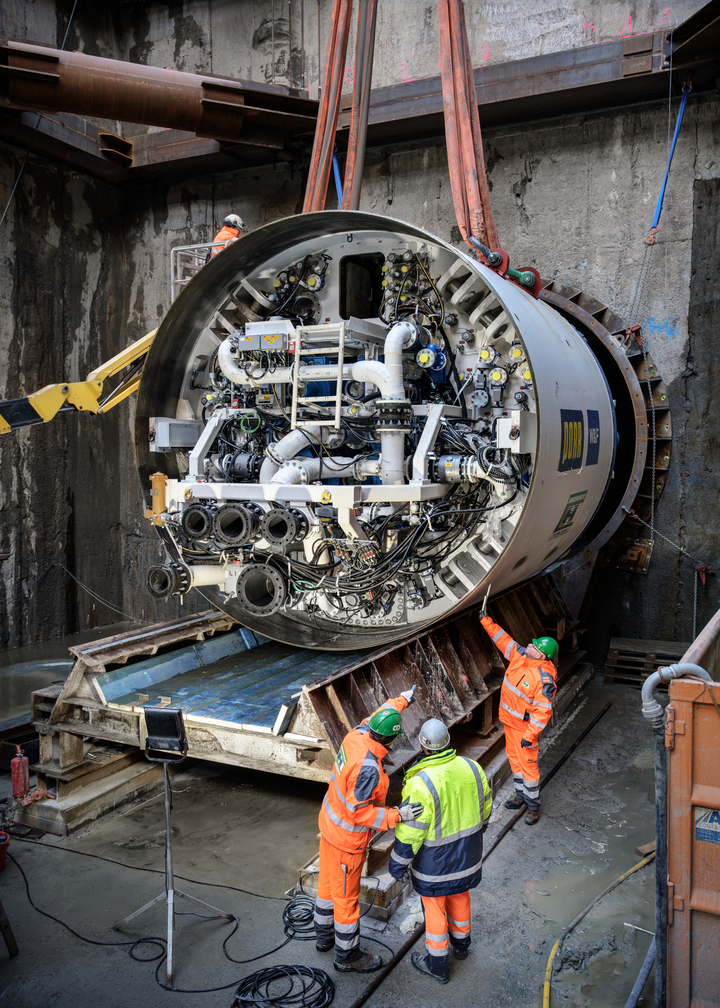
"The engineering challenge was to incorporate the technology of a highly complex Mixshield into a machine with a diameter of just under five meters: the conveyor system, electrical systems, hydraulics, ventilation systems, the transport system for the segments, and walkways for the crew on the machine.
"The systems supplying the machine are therefore distributed across twelve gantries," said Project Manager Faißt, who regularly visited the machine during the construction period.
Herrenknecht divisions
Herrenknecht Separations supplied a custom-designed separation system with chamber filter presses for dewatering fine solids, as well as two water treatment plants at the launch and reception shafts.
The separation plant ensured a continuous slurry cycle, thereby enabling stable and high-performance tunnelling by the tunnel boring machine.
"The filter presses ensured efficient dewatering of even the finest particles, thereby reducing disposal effort and costs," explained Gino Vogt, Head of Herrenknecht Separations.
The two water treatment plants at the start and end shafts ensured the resource-efficient provision of process water as well as its safe treatment and discharge back into the Elbe River in compliance with strict environmental regulations.
Herrenknecht Formwork, meanwhile, manufactured the segment formwork – including 3D surveying – for the production of prefabricated concrete segments for the tunnel construction, as well as the handling equipment for demoulding, turning, and transporting the segments.
The 5.2km long tunnel structure consists of about 4,000 segment rings, each of which is 1,300mm wide and composed of six elements.
The formwork ensured the highest level of dimensional acacuracy throughout the entire production process for the 24,000 tunnel segments – a crucial prerequisite for the precise fit of the segments and, consequently, the quality of the tunnel structure.
PORR is constructing the cable tunnel for the SuedLink Elbe crossing on ehalf of the transmission system operator TenneT. PORR commissioned the ARGE Tunnel ElbX – a joint venture between PORR and Wayss & Freytag Ingenieurbau AG – to build the tunnel.