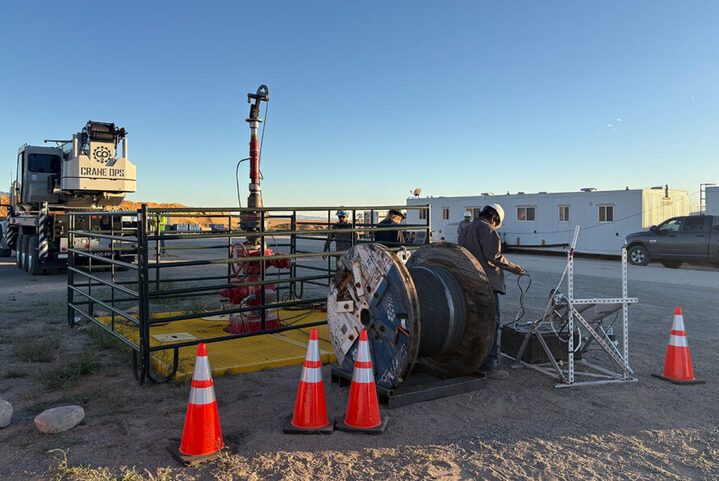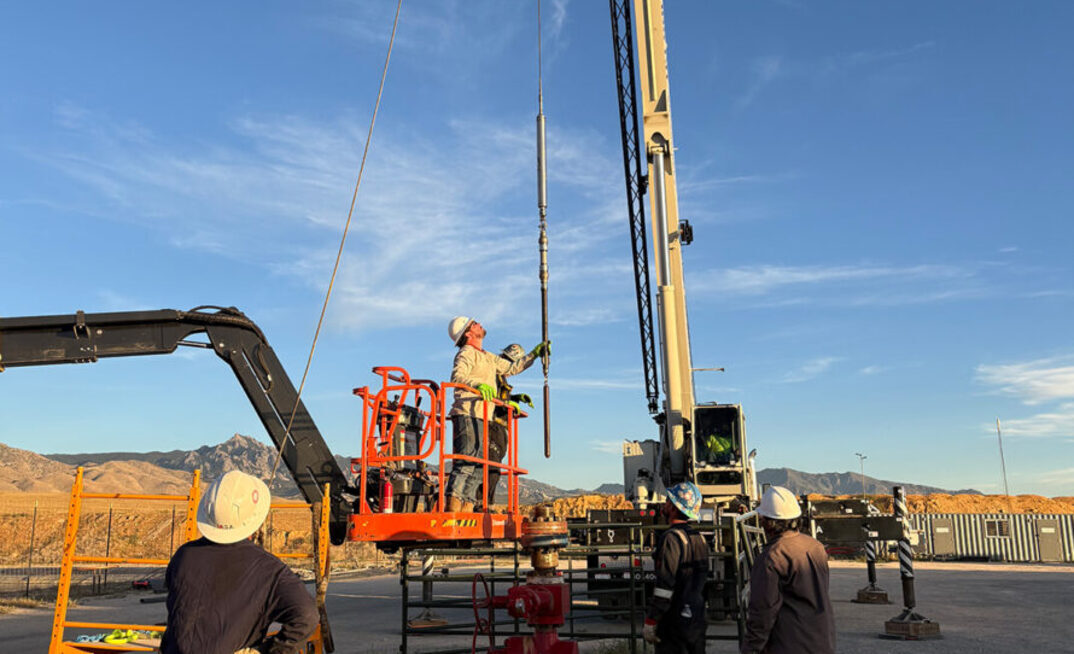


Geophysicists at the Lawrence Berkeley National Laboratory (Berkeley Lab) have developed a geothermal monitoring technology capable of withstanding extreme heat at greater depths.
The Berkeley Lab-designed seismometer was used at Fervo Energy's Utah EGS site, Cape Station, where the 10ft long sensor was sent down a 7000ft borehole hitting temperatures up to 338°F.
"Such high-temperature measurements are critical for geothermal energy production, and as far as we know, this is the world's longest recorded measurement at this temperature," said Berkeley Lab staff scientist Nori Nakata.
Nakata developed the high-temperature sensor with Paul Cook, a scientific engineering associate at the laboratory's Geosciences Measurement Facility (GMF). "If we can advance the science needed to achieve round-the-clock monitoring of EGS operations, it will help expand enhanced geothermal systems effectively and safely," she said.
YOU MIGHT ALSO LIKE
Cape Station
Since 2023, Fervo Energy's Cape Station has served as a hub for research advancing geothermal development in southwest Utah, a region where hot subsurface conditions mirror those found throughout the geothermal-rich American West.
The Houston-based company plans to deliver its first 100MW of continuous Cape Station power by 2026.
Heat exists almost everywhere underground, but many rocks lack the permeability needed for fluid to flow and transfer heat effectively. Most sensors used to monitor these flow paths operate at depths less than 131ft where temperatures are cooler.
"Continuous seismic recording is important to expanding operations. For example, with more information about micro seismicity at greater depths, we can control fluid injection and circulation within the reservoir so it efficiently produces the steam that is converted to electricity," said Nakata.
Sireesh Dadi, Fervo Energy's data acquisition and advanced analytics manager, said: "Developing sensors that can reliably operate at high temperatures is a game-changer for geothermal energy. We're advancing tools for micro seismic monitoring, pressure sensing, and strain sensing that help us better understand reservoir behaviour in real time."
Most sensors used to monitor these flow paths operate at depths less than 131ft
The Berkley Lad team has also developed widely used software to simulate reservoir processes that may help identify promising EGS sites and track reservoir performance over time. The team is also applying advanced data processing and artificial intelligence to fuse diverse datasets, uncover patterns that would otherwise remain hidden, and support better decision making in reservoir management.
"We want to know the true conditions inside a geothermal reservoir, but that's difficult to see directly," says Nakata. "For EGS to become a major U.S. energy source, we need a clear understanding of rock stress, permeability, fluid pathways, and fracture growth. These factors are critical both to generate electricity and to avoid unwanted induced seismicity."