

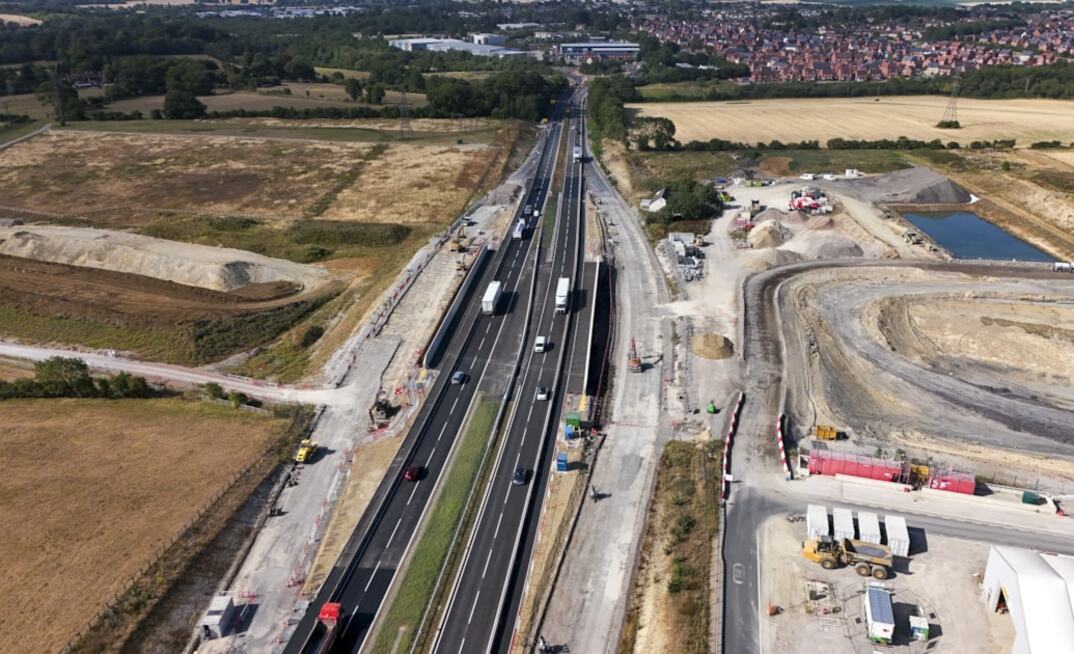


A major milestone has been reached on the UK's controversial HS2 rail project with the successful realignment of both carriageways of the A43 near Brackley, Northamptonshire.
The bridge will now be completed to allow high speed trains to pass under the busy road.
Preparatory work began in 2023, when HS2 engineers worked closely with National Highways to realign the A43 and create an "island" between the two carriageways large enough to construct a new bridge while keeping traffic moving.
Using a ‘top-down' approach, they sank 52m deep piled foundations and then built the pile caps and piers that support the 66m long bridge deck that carries the road. Seven huge steel beams were then lifted into place to support the concrete deck.
YOU MIGHT ALSO LIKE
With traffic now flowing in both directions, excavation can begin to create space for the railway to pass underneath.
This multi-stage approach was designed to keep traffic flowing and disruption to a minimum. The final closures were also delayed to avoid the F1 British Grand Prix, which was held at Silverstone at the beginning of July 2026.
The 50 mile (80km) stretch of railway that passes Brackley – including the A43 bridge – is being delivered by HS2's main works contractor EKFB, a team made up of Eiffage, Kier, Ferrovial Construction and BAM Nuttall working with ASC (a joint venture between Arcadis, Setec and COWI).
EKFB's Project Director, Tony Wehby, said: "Completing the construction works on the A43 marks a significant milestone for the EKFB team and its supply chain partners. This completion now allows us to the remove material from underneath the road and press ahead with our earthworks programme in this area." In total there are more than 500 bridging structures on the HS2 project. These range from small footbridges and culverts, to innovative ‘green bridges' designed to help wildlife cross the railway, massive motorway crossings and the record-breaking Colne Valley viaduct."
The new high-speed railway is designed to improve connections between London, Birmingham and the North while freeing up space for more local trains on the most congested southern end of the existing West Coast Main Line into London Euston.













