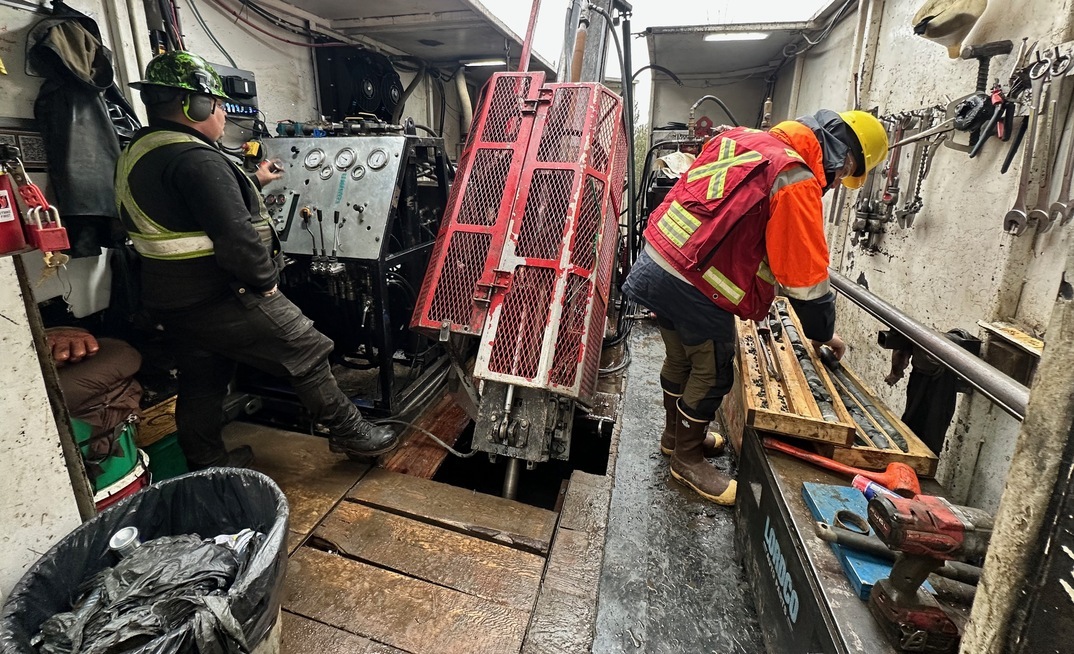


Readers of a certain age will recognise the headline above as the title of Monty Python's cinematic compendium of skits from the iconic TV shows of the early 1970s. But it also perfectly describes the approach Len Brownlie, as President and CEO of Canada's Prospect Ridge Resources, is taking to drill five copper gold porphyry projects in British Columbia, the aptly named Camelot, Excalibur, Castle, and Holy Grail. (The Knauss Creek project has yet to be given a Python moniker, but GDI is pushing for the Knight of Ni).
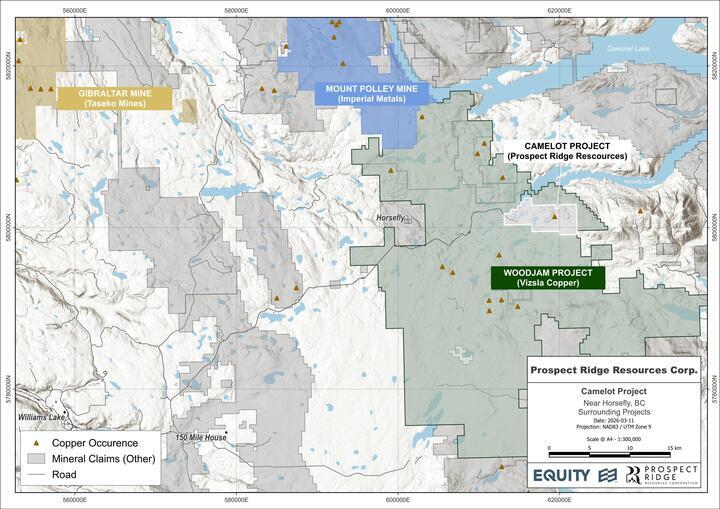
Listed on the Canadian Stock Exchange, the junior mineral exploration company announced assay results from its 100% owned Camelot project in February, confirming a mineralised porphyry system. It also demonstrated how targeted geophysics, favourable logistics and a disciplined drill team can significantly improve exploration efficiency and reduce costs.
The property, a 26km2 site about 34km southeast of Imperial Metals' Mt. Polley mine and 13km northeast of Vizsla Copper's Woodjam project, is centred on the Lemon Lake stock. Camelot, and Prospect Ridge's wider programme, forms part of a broader plan to identify large-scale copper-gold porphyry deposits within the Quesnel Terrane, a geological belt that has hosted the majority of British Columbia's hard rock mines over the past three decades.
YOU MIGHT ALSO LIKE
Red Herrings
Porphyry deposits in this region tend to be low grades but high in volume, allowing for open pits with long lifespans. However, Brownlie says that "a lot [of the deposits] are covered by shallow glacial till and haven't been found yet," highlighting the need to rely more heavily on geophysical techniques rather than surface data alone.
"It's not that the soil anomaly proved to be a red herring," he explains, "but it indicates that something was nearby, just not necessarily directly beneath the anomaly itself."
This is where magnetics and chargeability come in. The Camelot programme combined induced polarisation (a method used to map chargeability and resistivity) with magnetic surveys and modern drilling techniques.
The first campaign was completed in November 2025 – just three months after Prospect Ridge picked up the project – and involved 2034m of NQ core drilling over a 19-day period, with drilling carried out by Dorado Drilling, and Equity Exploration Consultants providing geological oversight.
From an operational perspective, the programme benefited from unusually favourable site conditions for BC. The site is road-accessible in an area that the Brownlie describes as "probably the easiest drilling scenario that we'll ever come across," comparing access conditions to "walking through an urban park with half the tree cover.
"The roads are fantastic. [The area] has been logged a couple of times and, as it is range land, there's cattle roaming around, chewing their cud. We take every effort to minimise any disturbance to the natural environment, but because there were roads in place and we are not felling trees, we are not disturbing the environment to any great extent."
A textbook drill
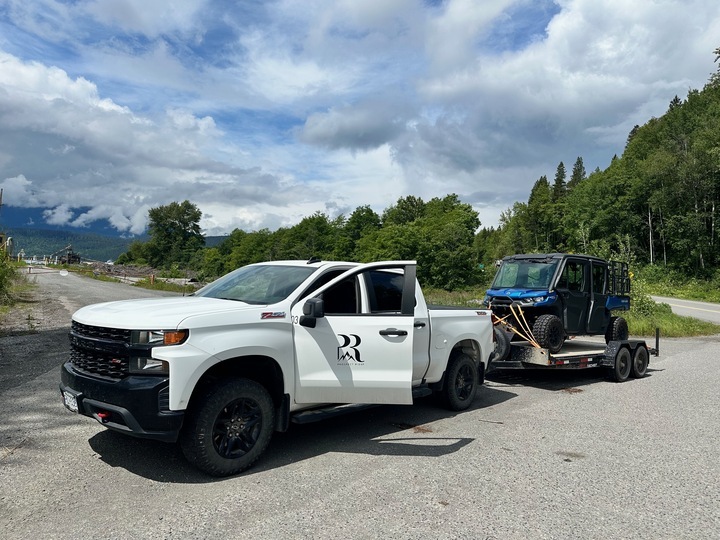
Road access helped keep a lid on project costs, negating the need for helicopter-support which usually adds north of $1500/m to projects in more remote areas of the province. Prospect Ridge completed the Camelot drill for less than $500/m.
Skid-mounted drill rigs also kept the costs down as they could be repositioned quickly, reducing the time it took to move between the ten boreholes. This meant that the Dorado Drilling team could maintain operations with just two drill crews working in tandem 24/7, drilling in excess of 100m a day before the winter weather took hold.
"It was almost a textbook drill programme," says Brownlie, citing strong contractor coordination, efficient logistics and the availability of a well-equipped local facility for core handling and processing.
Assay results confirmed a new copper-gold alkalic porphyry system at the project.
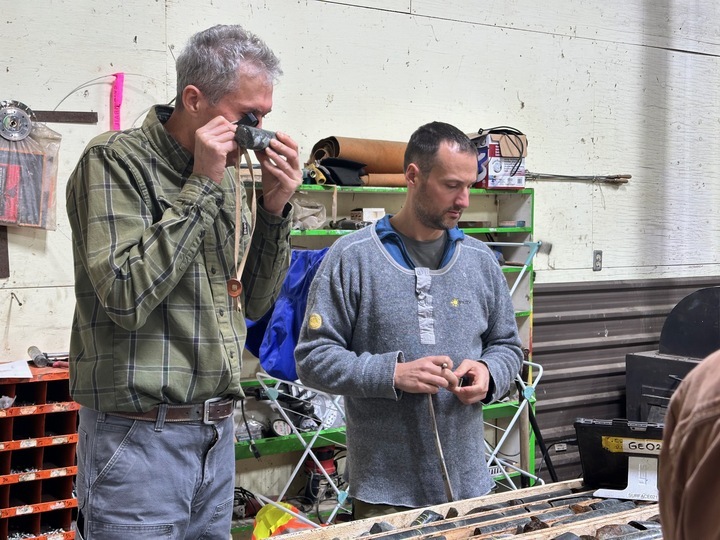
Drill core from CAM25-009 returned 0.07g/t Au and 0.08% Cu over 156.6m from 23.4m depth. Sampling of historical hole LL-22-01, drilled from a similar collar location but in the opposite direction and away from the core geophysical target, returned 0.07g/t Au and 0.06% Cu over 153m from 5m depth. Assays from the other nine holes were generally lower grade but still significant.
It was almost a textbook drill programme
"To be frank," Brownlie says, "those grades are not economic on their own, but they do indicate that we have a mineralised porphyry system. When you start seeing higher grade sub intervals, which are above the threshold that would be mined at, say, Mount Polley, it indicates you've got some kind of system there. There is quite high sulphur content in most of the drill core, which indicates a lot of pyrite. There is more or less a one-to-one correlation between gold and copper grades, which means that, towards the centre of the porphyry, where copper grades are expected to rise, gold could be an important byproduct."
X-ray vision
An interesting aspect of the Camelot drill was the use of a portable X-ray fluorescence (pXRF) tool to get "a pretty good handle on some of the basic minerals we were looking at".
The handheld analyser was used on each metre of core to get an early idea of the lithology and an understanding of where the higher amounts of copper mineralisation might be. But in future "we will probably grind a trough in the core, gather up the dust and then use the pXRF on that. We found homogenisation gives you a much better sample size. The other way to do it is to take the sample when the core is being split and capture the cuttings and subject that to XRF."
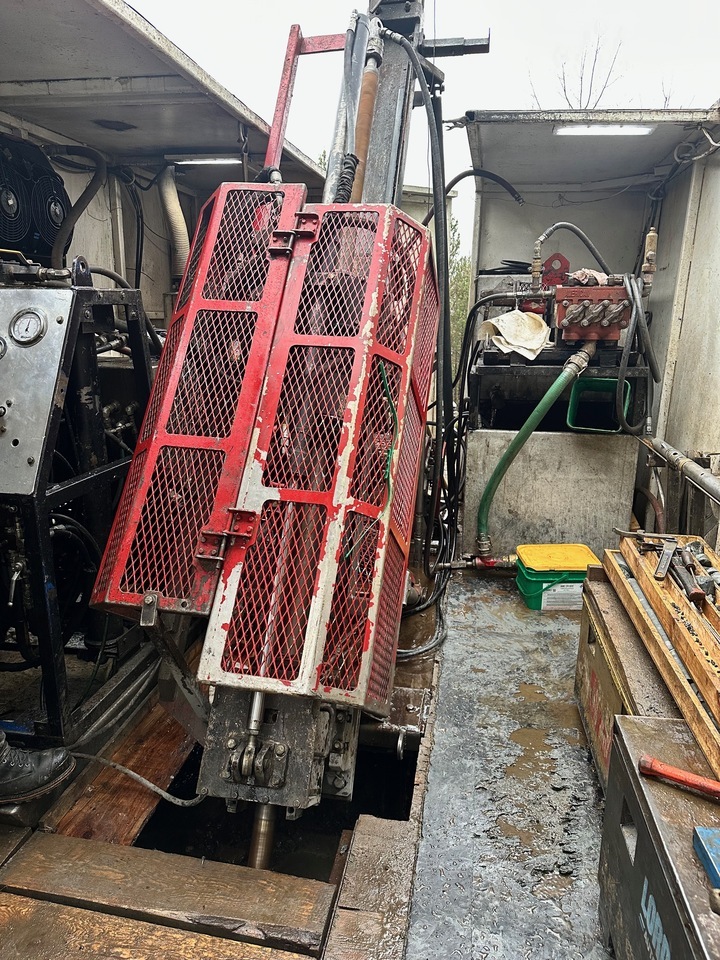
Encouraged by the Camelot results, Prospect Ridge is now preparing for a follow-up drilling programme, expected to take place in autumn 2026. This next phase will involve about 2000m of drilling, but in fewer, more targeted holes, focusing on locating the centre of the porphyry system, where higher-grade mineralisation is typically concentrated. Planned work includes hyperspectral analysis of drill core, high-resolution drone-based magnetic surveys and a re-interpretation of existing geophysical datasets.
Before that, however, in the summer, exploration drilling will start on Excalibur where 3000m will be drilled across five to eight holes, with company preparing for depths down to 600m. Prospect Ridge hoped to use the same Camelot contractors once drill permits have been received. The company also plans to start mapping the Castle property, which consists of 14 contiguous mineral claims covering 29.14km2 in the prolific Toodogone gold-copper mineral district in north-central B.C. Castle is located roughly 100km north-west of the Kemess mine and 66km south-east of the advanced stage Kutcho Copper VMS deposit and is accessible by helicopter from the Sturdee airstrip. The main target is an alkalic Cu-Au porphyry deposit at depth.