

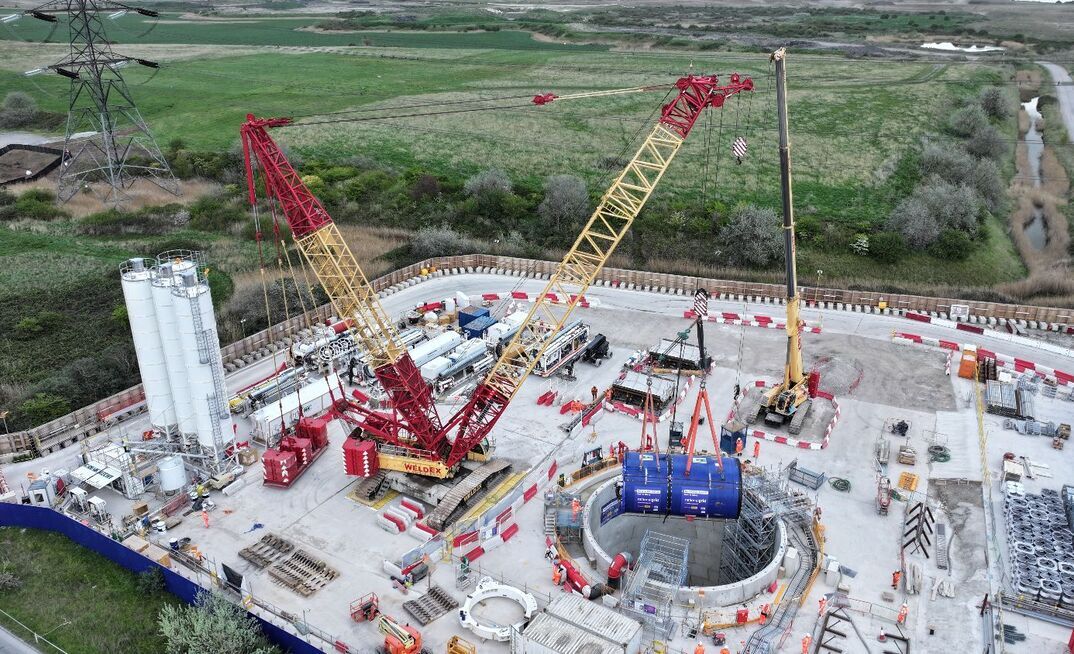


The National Grid, the operator of the UK's energy transmission network, has started tunnelling under the River Thames as part of the Grain to Tilbury element of the wider "Great Grid Upgrade", a multi-project investment to overhaul the country's ageing electricity grid.
A Herrenknecht Tunnel Boring Machine (TBM), designed and built specifically for the project, deployed at the beginning of May and is now slowly tunnelling from Gravesend, a town in Kent, to Tilbury, in Essex, on the north side of the river. The tunnel, under construction by the Ferrovial Bemo joint venture, will facilitate the laying of a 400kV power cable some 2.2km in length.
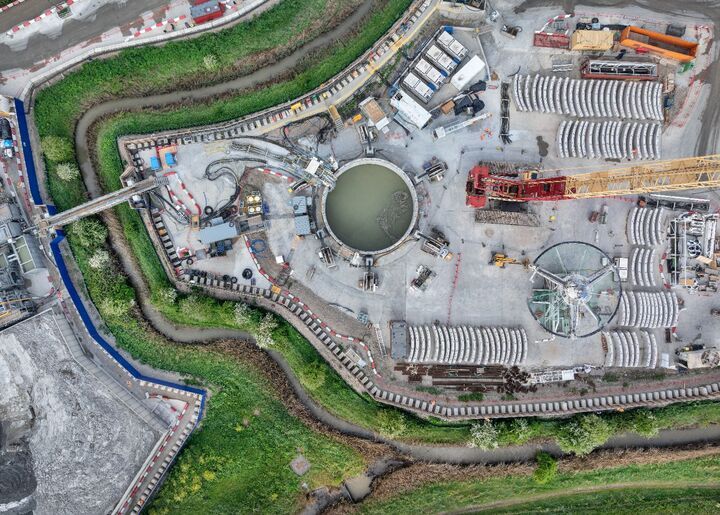
At 108m long and with a 4.7m diameter, the 460t Mixshield-type TBM has a 720kW cutterhead designed to breakthrough chalk and flintstone up to a compressive strength of 1000MPa. It can also deal with the challenging 4.5bar pressure it will encounter beneath the tidal Thames, where the river flows into the North Sea.
YOU MIGHT ALSO LIKE
While the cutting face is impacted by the high pressure, elsewhere the machine is maintained at atmospheric pressure by way of a multiple sealing system designed to protect against the crushing forces at depths of 41m. However, for work at the tunnel face, such as changing the cutting tools on the cutting wheel, an airlock allows crews to acclimatise safely.
During excavation, the TBM – named after Dame Caroline Haslett, an engineer and the first secretary of the Women's Engineering Society – will line the 4m internal diameter tunnel with precast concrete segments. When navigating tight curves and bends, however, the tunnel diameter can be increased using the machine's hydraulic over-cutter. This has a curve radius of 350m, allowing the machine's crew to make course corrections more easily.
Due to the complex geology, the Mixshield TBM is designed with a mini-gripper and anti-roll fins. These components allow the machine to be secured should the cutting wheel need to be retracted for whatever reason. It also features a drilling rig for preliminary exploration and a telescopic camera to inspect the tunnel face without the need for hyperbaric intervention by the crew. This means that any obstacles in the ground can be detected and any necessary precautions made.
Herrenknecht's scope of supply also included a separation plant, navigation technology from subsidiary VMT, and multi-service vehicles for transporting segments from the launch shaft to the TBM inside the tunnel.
At the Tilbury end, on the north bank of the Thames, 45m-deep launch and reception shafts used a 15.9m Vertical Shaft Sinking Machine (VSM), Europe's largest, with excavations taking just four weeks.
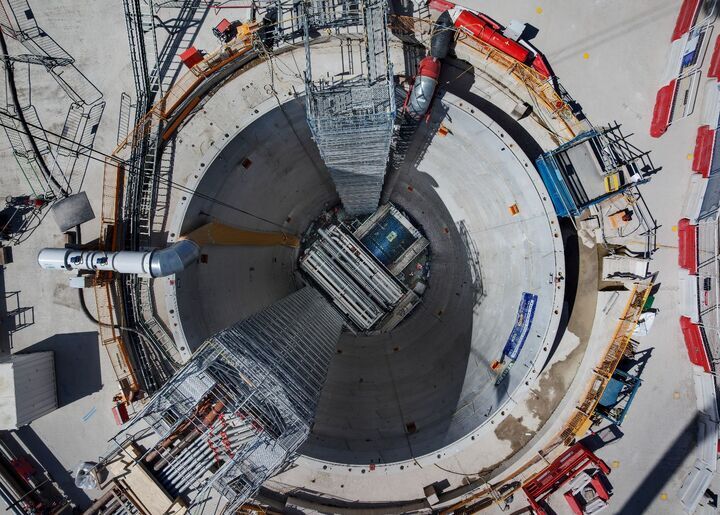
The soft soil and high groundwater conditions made light of the work, since it avoided costly groundwater dewatering. And by simultaneously driving the shaft wall and constructing the rings, driving speeds of up to 2.7m/d were achieved, shortening construction time and minimising the environmental impact that may have been encountered on other terrains.
After completion, in December, the VSM – named after Verena Holmes, the first female mechanical engineer member of the IMechE – was dismantled and transported to the Gravesend site to excavate shafts 48m deep. This work was finished at the beginning of May, before the TBM flashed up.
At the launch of the TBM, Ulrich Schaffhauser, a member of the Herrenknecht board, said: "River crossings are key in grid construction, and safety comes first in shaft and tunnel works. In addition to the VSM, which has safely sunk the launch shaft, we are proud to deliver a tailor-made Mixshield TBM for the cable tunnel."
The new tunnel will replace the existing Thames Cable Tunnel which, at more than 60 years old, is at the end of its design life. Two headhouses either end of the tunnel will connect the existing overhead line to the new cable in the tunnel, and to the rest of the electricity network.
Mark Farmer, Project Director, National Grid, said: "The arrival of the tunnel boring machine is a significant milestone for the Grain to Tilbury project and a major step forward in strengthening the electricity network in this area for years to come. This important project will help ensure secure, cleaner, home‑grown energy can continue to flow across the network as demand increases."













